


On April 1, 1976, ”fifty years ago in a small garage, a big idea was born.” Those were CEO Tim Cook’s words to mark Apple’s 50th anniversary. A popular narrative suggests Steve Wozniak and Steve Jobs, two founders, tinkering away and making sales calls in a messy garage. It’s a great story, iconic in the Valley, and symbolic of the gritty, self-start culture of the era. Yet, it’s incomplete. The garage was real, but Apple’s origins can be traced even earlier. [1]
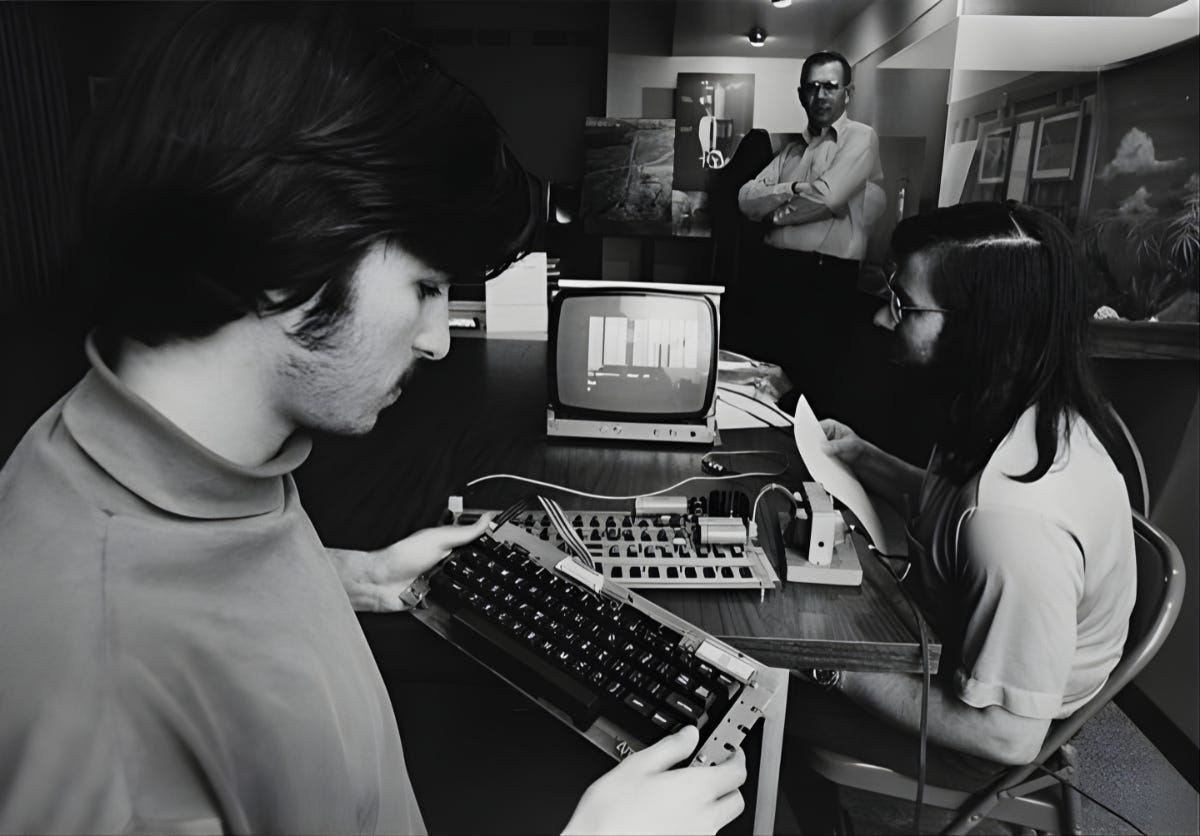
To find that part of the story, one must travel back to March of 1975. This was before Apple existed, and when the concept of computing was largely relegated to geeks and computer hobbyists. Yet, an enthusiastic group of them decided to start gathering as the Homebrew Computing Club in Menlo Park, CA. There was no business plan or agenda, but just nerds nerding out. Members would bring parts, schematics, and half-finished designs, all trying to imagine some distant future where computers were in every household. Steve Wozniak was one of these nerds. [2]
The Apple I and II were designed strictly on a hobby, for-fun basis, not to be a product for a company. They were meant to bring down to the club and put on the table during the random access period and demonstrate: Look at this, it uses very few chips. It’s got a video screen. You can type stuff on it.
— Steve Wozniak [3]
Wozniak had no intention to sell his circuit board. Rather, he was deeply inspired by the collaborative and intellectual culture of the club, one in which curiosity was prioritized over commercialization. In fact, Woz produced the initial design as a way of “showing off” to the people at the club. [4] He loved elegance, and with its affordability and built-in video display, the club loved his build. With this environment, the Apple I received a unique kind of development.


“[It was] shown off every two weeks at the club meeting … We’d get some positive feedback going and turn people on. It’s very motivating for a creator to be able to show what’s being created as it goes on,” he described. Through this space, Wozniak was able to gather steady feedback from similar minds and make constant tweaks for improvement. Further, he never had to worry about “a million people trying to steal it”—these people weren’t greedy businessmen, but just passionate technologists. [3]
It was also this excitement around Woz’s design that sparked an idea in the mind of an onlooker, Steve Jobs. With a sharp acumen for sales, Jobs speculated that demand for such a product might exist beyond this group of geeks. [4] From there, he spoke to Paul Terrell, owner of the local Byte Shop, who placed an order for 50 (how touching). From there, Apple commercialized, and the rest is history … in-brief.
Perhaps this story is most important not as a myth-busting tidbit, but a reminder that technology is very rarely created in a vacuum. The Apple I was a product of Menlo Park’s culture of technological curiosity, one that was institutionalized via Homebrew. These institutions are centered around nerds like Wozniak, many of whom are willing to spend years in R&D, but occasionally strike gold. Now that’s what I call thinking different. So, Apple, here’s to 50. Happy birthday.
LET ME KNOW YOUR THOUGHTS!
Endnotes
Apple, “50 Years of Thinking Different,” accessed April 3, 2026.
https://www.apple.com/50-years-of-thinking-different/
Computer History Museum, “Apple Timeline,” accessed April 3, 2026.
https://computerhistory.org/apple-timeline/
Steve Wozniak, “Homebrew and How the Apple Came to Be,” The Digital Deli, accessed April 3, 2026.
https://www.atariarchives.org/deli/homebrew_and_how_the_apple.php
Computer History Museum, “Steve Jobs,” accessed April 3, 2026.
https://computerhistory.org/blog/steve-jobs/