


I generally like to think that our elected representatives know their stuff. I mean, most of them have gone to law school, right? 13% of the Senate is Harvard-educated. [1] And that’s precisely why the following scene baffles me so much.
It was April 2018, and Facebook was in trouble. Throughout the 2010s, a British consulting firm called Cambridge Analytica (CA) had been scraping data from the social media giant for political advertising. CA had also played a significant role in Donald Trump’s 2016 campaign by psychologically profiling users. [2] Of course, like most data scraping, it was without informed consent. An estimated 87 million people were impacted. [3] So, when whistleblower Christopher Wylie (former CA employee) leaked documents to the press, Mark Zuckerberg needed to respond.
Called to testify before the Senate on April 10, Zuck’s testimony was meant to address issues of data privacy, platform responsibility, and the growing power of social media. What it more clearly revealed was a gap in understanding. [4]
Sen. Orrin Hatch (R-UT): “How do you sustain a business model in which users don’t pay for your service?”
Zuck: “Senator … we run ads.”
Hatch: “I see. That’s great.”
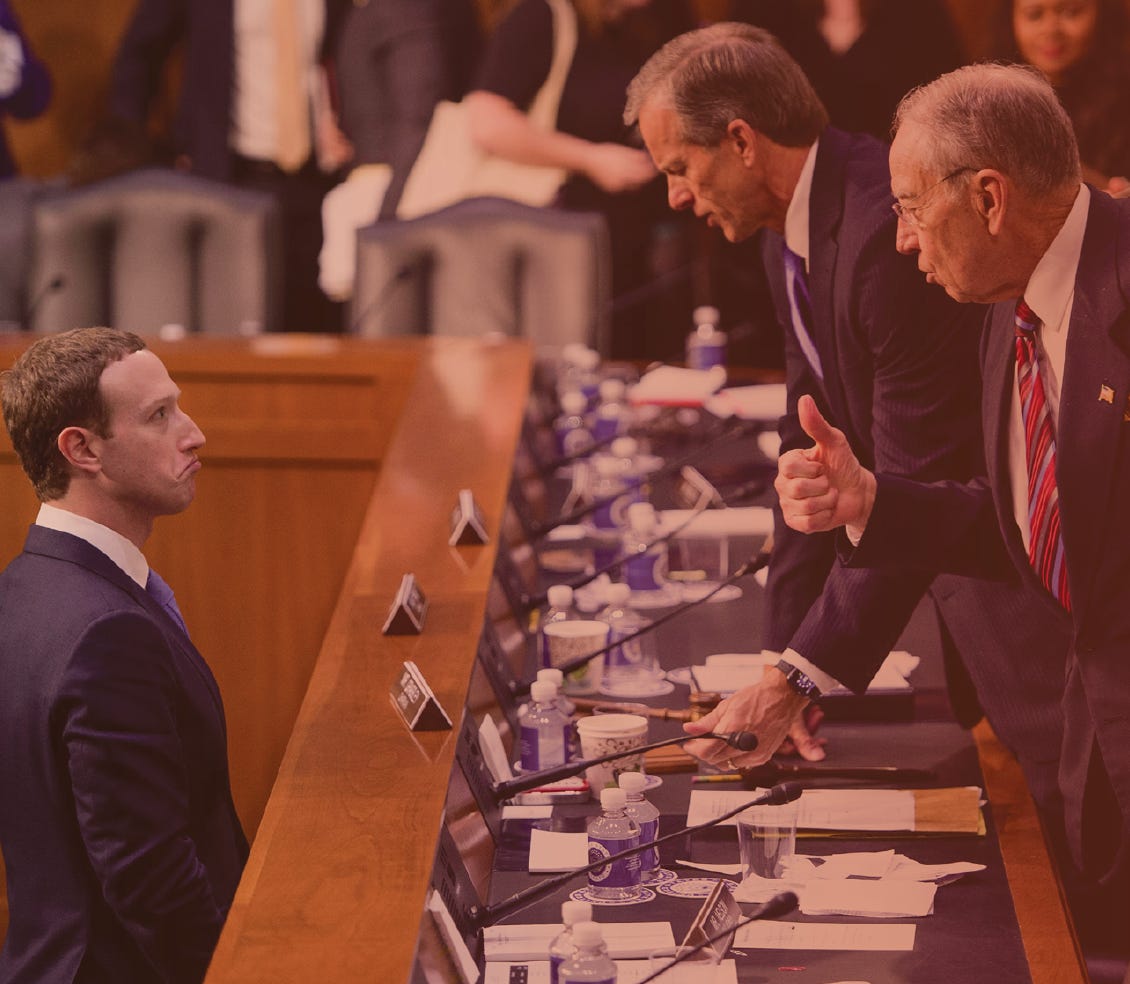
Of course, it was a small exchange. In fairness, the viral clip was somewhat taken out of context. [5] But, when I—like millions across the country—first saw it happen, I felt deeply concerned. With an aging group of policymakers, but an increasingly rapid pace of innovation in technology, how can we expect Capitol Hill to keep up? They struggle to grasp the basic mechanics of the systems they are tasked with fixing.
What happened in 2018 was somewhat embarrassing. Each Senator was allowed only five minutes, and what were supposed to be “hard questions” just made the group look ill-prepared. [4] Moments like this have become increasingly common, too. With the onset of artificial intelligence, corporations are pleading for regulation, yet Congress just can’t give it to them like they want. The two groups—technologists and policymakers—often fail to understand one another.
And that’s important. It’s not just those on the Hill, but the technologists too. Executives as well as their engineers will focus on capability, efficiency, scale, and performance, but then forget the metric of human consequence. Whether those at Instagram make their algorithms as addictive as possible, or the rapid development of AI inextricably causes labor displacement, they are all symptoms of the same underlying problem. [6]
The divide isn’t new, though. In fact, it was most explicitly identified more than half a century ago by C. P. Snow. Born in Leicester, England, Snow was uniquely positioned to identify a problem with the modern West. With an educational background in the sciences, receiving his physics doctorate from Cambridge in 1930, yet a professional background in the literary arts as a successful novelist and public intellectual, he had seen both sides of the story. [7]
So, when he was invited to deliver the prestigious Rede Lecture at Cambridge in 1959, he took a stab at it.
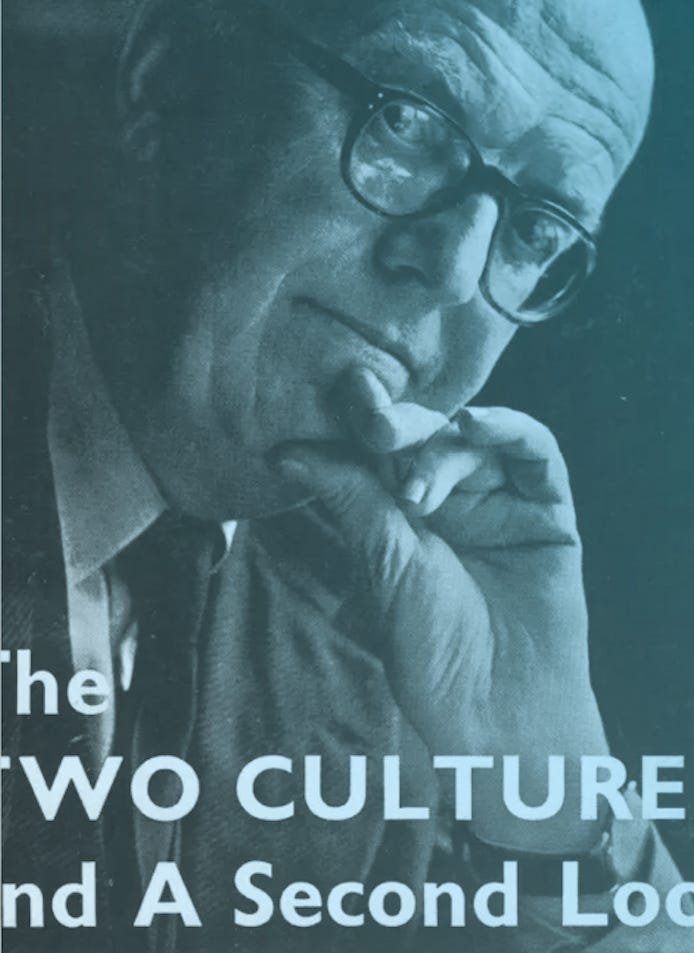
“I believe the intellectual life of the whole of western society is increasingly being split into two polar groups,” Snow stated. “Literary intellectuals at one pole—at the other scientists … Between the two a gulf of mutual incomprehension—sometimes (particularly among the young) hostility and dislike.” [8]
I couldn’t put it better myself. In fact, I see this phenomenon all the time. Look at the modern education system: students, as early as their adolescence, are pushed into one of two groups. Either you study “STEM” or the humanities, and no matter what, you will come to condemn the other side. Entire cliques are formed over this “mutual incomprehension.” For those who only love the sciences, literature and philosophy are the kinds of subjects where students frolic in gardens and add no societal value. Those with knowledge just in the literary arts stereotype “computer science nerds” as chronically online, but themselves suffer from staying behind in a world where technology keeps moving forward.
It is basic economic logic that people should specialize to maximize output. What arises is a negative externality, though, insofar as there is a social element to the side you choose to join. For example, Snow noted, “The scientific culture really is a culture, not only in an intellectual but also in an anthropological sense … there are common attitudes, common approaches and assumptions.” [8] He continued, citing the general rise of atheism among scientists as compared to the rest of the Western world. “Statistically also, slightly more scientists are on the Left in open politics.”
Of course, none of this is a dig at scientists. These trends follow from two main ideas. Firstly, when faced with the choice between the sciences and the literary arts, there are many social factors at play. One’s family, economic status, and geographic location all influence that “decision,” and thus, you get many people who come from similar backgrounds in the same room. Secondly, though, the practice of science follows certain analytical and data-driven practices (the scientific method), which themselves mold the way in which scientists approach social issues.
Similar trends exist with the literary intellectuals, and they tend to themselves. It is a classic analysis of polarization: the speed at which two disparate groups culturally separate is exponential, because echo chambers become louder and, eventually, the social divide becomes institutionalized. “This polarisation is a sheer loss to us all,” Snow lamented. [8]
What was identified as an intellectual divide has, six decades later, manifested into something far more consequential. The technologies that currently shape our everyday lives—social media, the internet, and digital infrastructure—as well as those being developed—artificial intelligence, green energy, and quantum computing—are being built in one culture but used and governed in another.
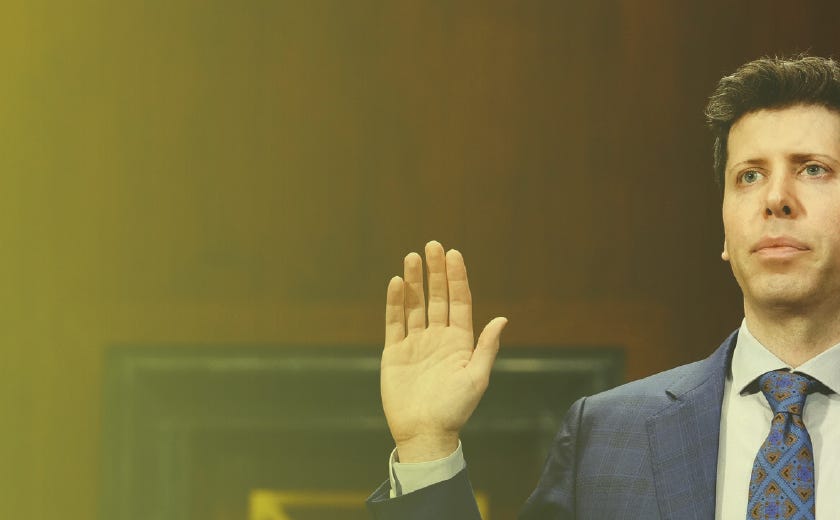
We see lawmakers struggling to regulate innovations that they don’t fully understand. More concerningly, it is not always clear that they are incentivized to do so. Meanwhile, technologists create products that don’t fully account for social externalities, mostly because there is a lack of intelligent regulation, but also because they themselves don’t have guardrails.
The mistake that this polarized society can make is to treat technology as something purely technical. It is not, and we see that every day. From autonomous drones being used in Middle Eastern warfare to geopolitical tensions in the Taiwanese Strait because of semiconductors, technology is shaped and shapes governments, markets, and cultural values. To understand said technology, then, is to not only understand how it works, but how it develops. Those who fund technology, who build it, who guide it, and the consequences that follow from it are all critical when leveraging and optimizing it. Without that broader perspective, we are left with fragments—unchecked technical knowledge or abstract social critique.

Technology is not slowing down. We are moving towards a series of years that will determine a long-term future for humanity. To set the momentum correctly, we must move beyond this divide. That is my goal for Aryan Talks Tech—and what I want to articulate here. I hope that each piece informs us on how technology, as a system shaped by policy, institutions, and markets, has developed over the past, and what it means for our future. Snow warned of a world divided into two cultures, and we see it happening in real time. The challenge is no longer to simply recognize this gap, but to bridge it.
SHARE THE POST WITH FRIENDS!
LET ME KNOW YOUR THOUGHTS!
Endnotes
1. Pew Research Center, “Nearly All Members of the 118th Congress Have a Bachelor’s Degree…,” Feb. 2, 2023.
2. Matthew Rosenberg et al., “How Trump Consultants Exploited the Facebook Data of Millions,” The New York Times, March 17, 2018.
3. Christopher Wylie interview, Business Insider, Oct. 2019.
4. NPR, “Mark Zuckerberg Senate Testimony,” April 10, 2018.
5. “Zuckerberg Senate Transcript,” Wikisource, 2018.
6. Stanford HAI, “Social Media Algorithms and Mental Health,” 2023.
7. American Physical Society, “C. P. Snow and the Two Cultures,” 2017.
8. C. P. Snow, The Two Cultures, Rede Lecture (Cambridge: Cambridge University Press, 1959).